A marketing platform where every campaign launched without learning from the last
Enterprise marketers were sending to thousands of customers with no way to know when, who, or how to optimise. I originated the concept that changed it — and it got built.
Pendula is a B2B SaaS customer engagement platform powered by AI. Non-technical marketers can build AI-driven, two-way conversations. The AI layer handles segmentation, behavioural triggers, and escalation decisions — think a telco sending 100,000 bill reminders via SMS, then intelligently handling every reply.
The problem
Marketers had no way to know when customers were most likely to engage, which audience would convert, or what the last campaign had revealed. We had direct evidence of the gap before the hackathon: one customer was paying for expert services to maintain three SQL files — updated manually, every day — to manage their audience segmentation. It worked, barely, and it wasn't going to scale.
The Innovation Olympics was an internal 5-week hackathon: 2–3 hours per week, a 6-minute pitch to external judges. I originated the concept, designed the wireframes and system architecture, and steered a cross-functional team of engineers, marketers, salespeople and product managers to a pitch that won first out of 6 teams.
The results
Campaign intelligence, built on your data
1st
place out of 6 teams in Pendula's hackathon, 'Innovation Olympics'.
for our AWS partner to deliver a production-ready prototype on Amazon Bedrock after the pitch won.
2-3h
per week — the time constraint forced the team to prioritise ruthlessly.
My role
Team
Concept originator (me!)
Engineers
Marketers
Sales
Product managers
Tools
Figma, Amazon Bedrock, Claude
skills
AI product design
Design strategy
Interaction design
Conversational UI
reflection
The concept flowed naturally from the reply matching feature. Working on how Pendula handled customer responses had made the data gap obvious; I understood where the friction was for marketers because I had spent months designing around it. The harder part was steering a cross-functional team without a design process to hold onto. Engineers engaged with the architecture diagram in ways they wouldn't have with a wireframe. Making the logic visible early meant the concept was something we all owned, not something I handed over. The shift from "here's what this does" to "here's what it costs you not to have it" changed how we framed every pain point.
discover: research
The pain points were hiding in plain sight
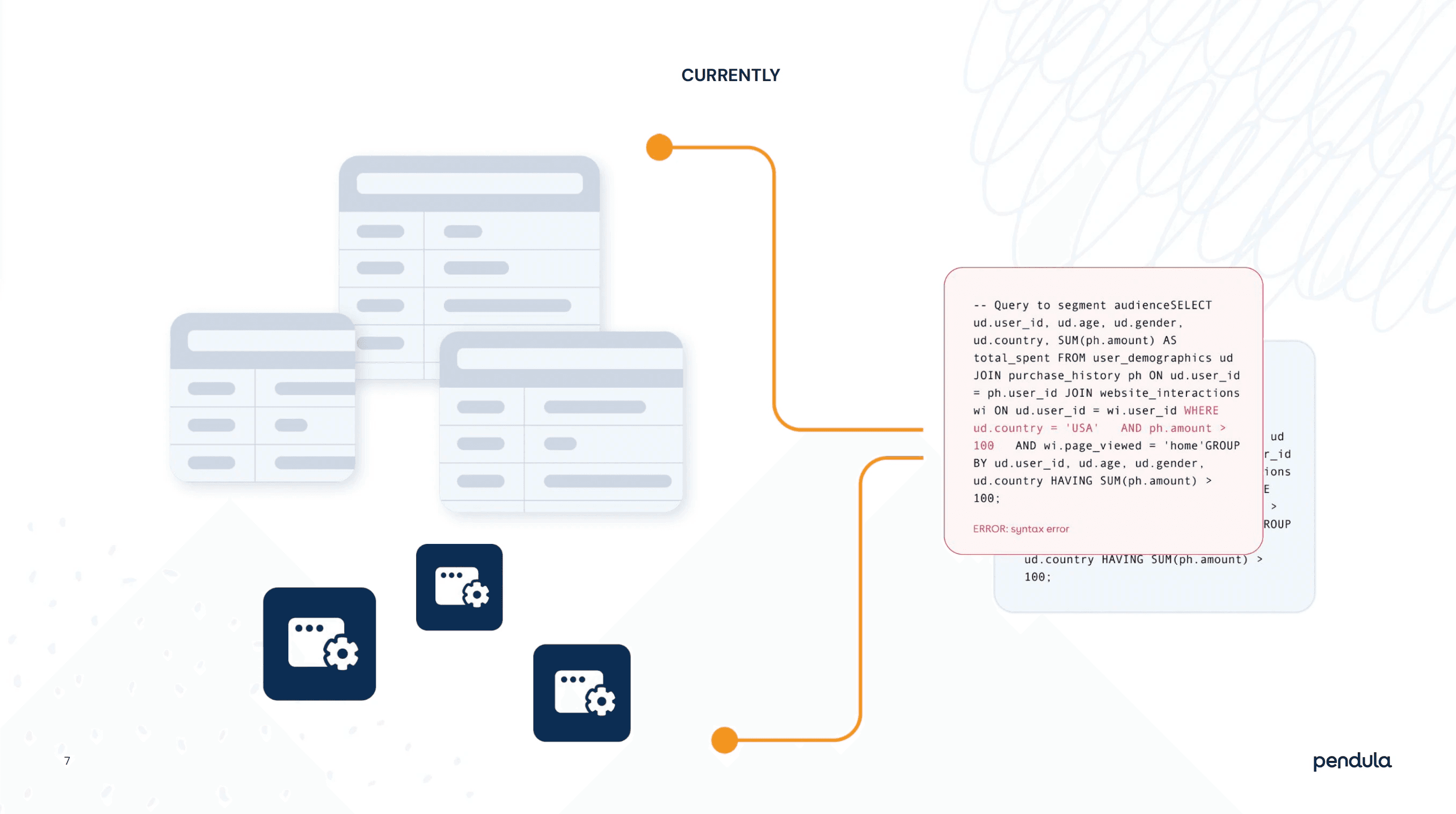
Customers were paying for expert services to maintain three SQL files — updated manually, every day — to manage their audience segmentation.
With 2–3 hours a week, there wasn't time for formal user research. Instead, we worked off what our team already knew — affinity mapping across CS support conversations, product usage patterns, and months of direct customer exposure surfaced four friction themes:No behavioural enrichment — customer responses weren't being fed back to improve future sends; every campaign started from scratch, ignoring everything the previous one had revealed. Disparate data — customer records lived across CRM, billing, helpdesk and customer success tools, making segmentation manual and slow. SQL dependency — audience segments required hand-written queries; error-prone for engineers, completely inaccessible for marketers, and requiring daily manual maintenance just to stay accurate. Limited integration — CSV uploads were a workaround because APIs weren't available for every system of record.
develop & define
The UX was the product
I built a service blueprint first — mapping how engagement data from multiple sources would feed the AI layer, how PennyAI would surface insights from that history, and how the audience builder would translate those insights into campaign-ready segments. Making the logic visible early gave the engineering team something concrete to engage with.

Running a workshop: Architectural diagram in how it could work with an existing customer
PennyAI's design focused on a conversational interface. A marketer asks in plain language; the answer comes back with supporting data and a direct action — set this as your send time, target this segment.
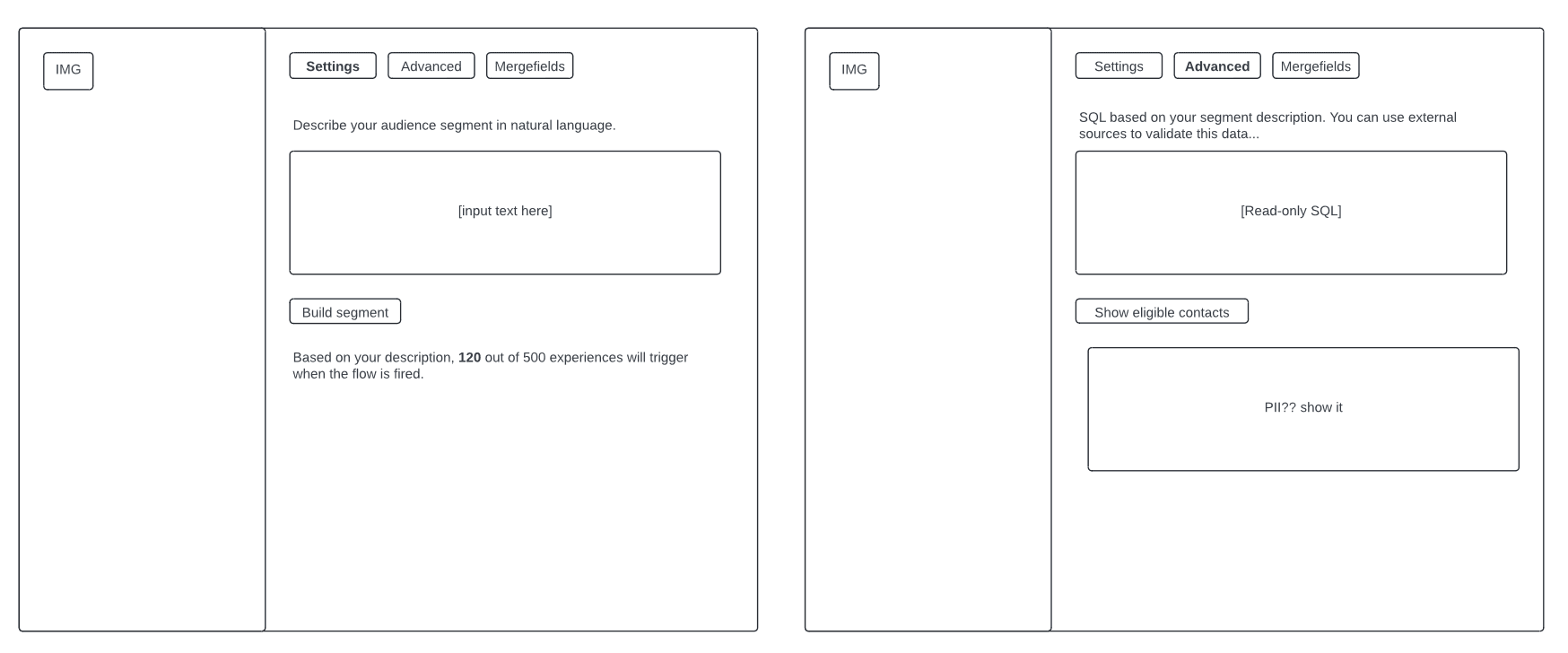
Wireframes created for the initial trigger nodes, to be used with the rest of the platform.
deliver: the solution
Hiding the complexity without removing it
Two connected features built on a single AI layer — designed to work with any underlying LLM. The core decision was the same for both features — hide the complexity, don't remove it. I demoed a high-fidelity prototype in the pitch itself, walking the judges through PennyAI's chat interface and the audience trigger live.
PennyAI, a generative AI insights assistant
Marketers can ask anything about their campaign performance: when to send, who to target, which channel converts best. The answers come from that tenant's own engagement history, not industry benchmarks. "What's the best time to send my SMS upsell flow?" gets "Your customers respond most on Thursdays at around 3pm."
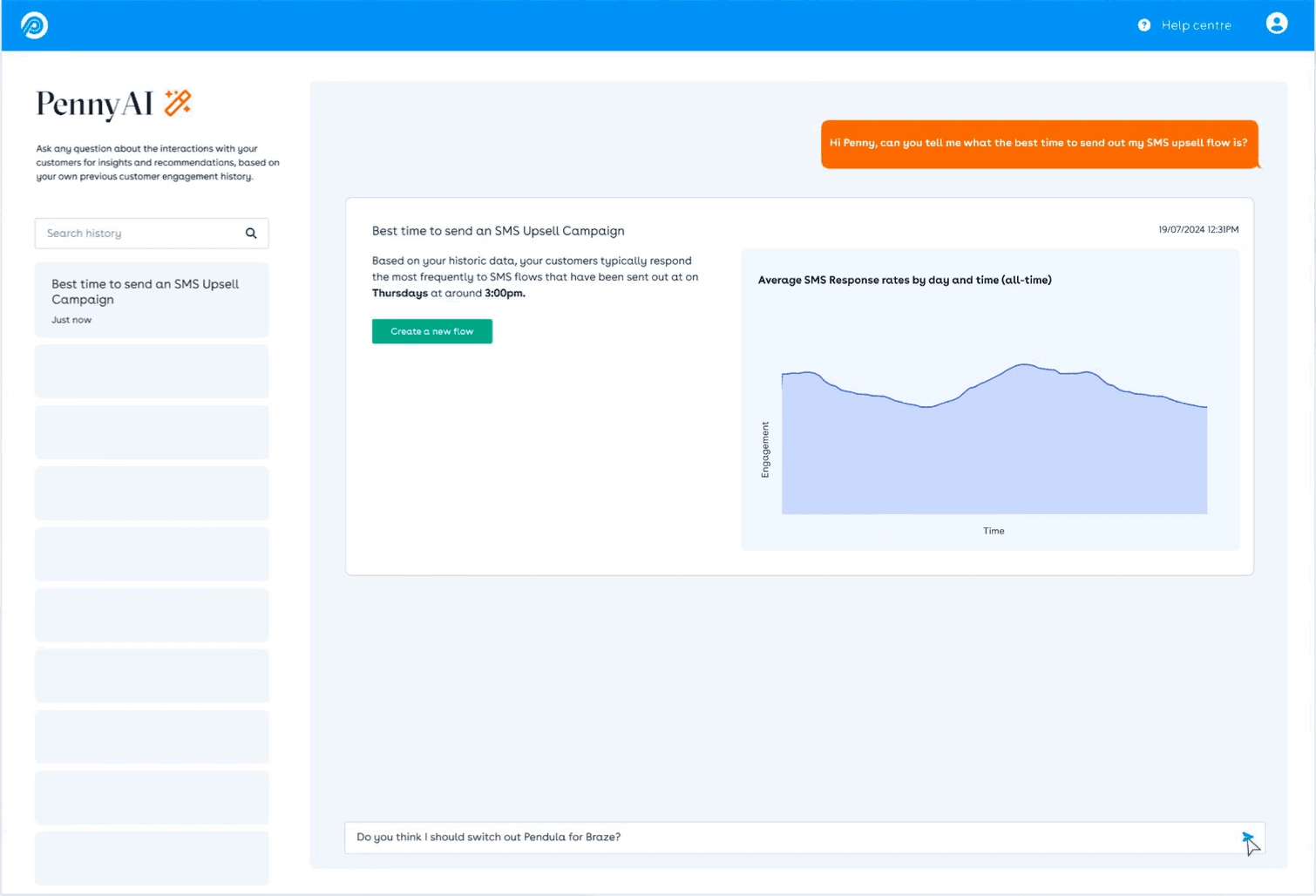
Penny's chat interface: a plain-language question, a data-backed answer, and a direct action.
Smart audience builder trigger
Equipped with Penny's recommendation, the marketer builds the campaign directly. They describe their audience in plain English — "Look for contacts on the Essentials prepaid plan, living in NSW or QLD." The trigger returns the audience count and sets the schedule. No SQL file and no engineering request. Settings tab: describe your audience, get a count back. Schedule tab: set the timing Penny recommended. Advanced tab: the generated query surfaces as read-only — engineers can validate, marketers never see it.

Smart Audience Builder — Settings tab: describe your audience in plain English and get an audience count back.

Schedule tab: set the send time Penny recommended, without touching a single field manually.
results
Our pitch won, and a production-ready prototype was built. The concept mapped to five documented business objectives:
Using real customer interactions to personalise beyond demographics
Eliminating the manual SQL file maintenance that didn't scale
Building audience cohorts in plain English, not code
Feeding engagement data back so customer profiles evolved with every send
Making that data usable to optimise timing, message length, and channel — not just who to reach, but when and how.
External judges from ReadyTech and the NDIS healthcare sector scored it first out of six pitches.
After the pitch won, the concept was pushed forward to an AWS Advanced Consulting Partner, DiUS. A production-ready prototype was built on Amazon Bedrock and delivered in four weeks. Throughout the build, the design team gave ongoing critique and feedback directly to the AWS Partner — I was part of that review loop at every stage. The concept was publicly referenced in DiUS's strategic collaboration agreement with AWS.
Pendula was acquired in August 2025.